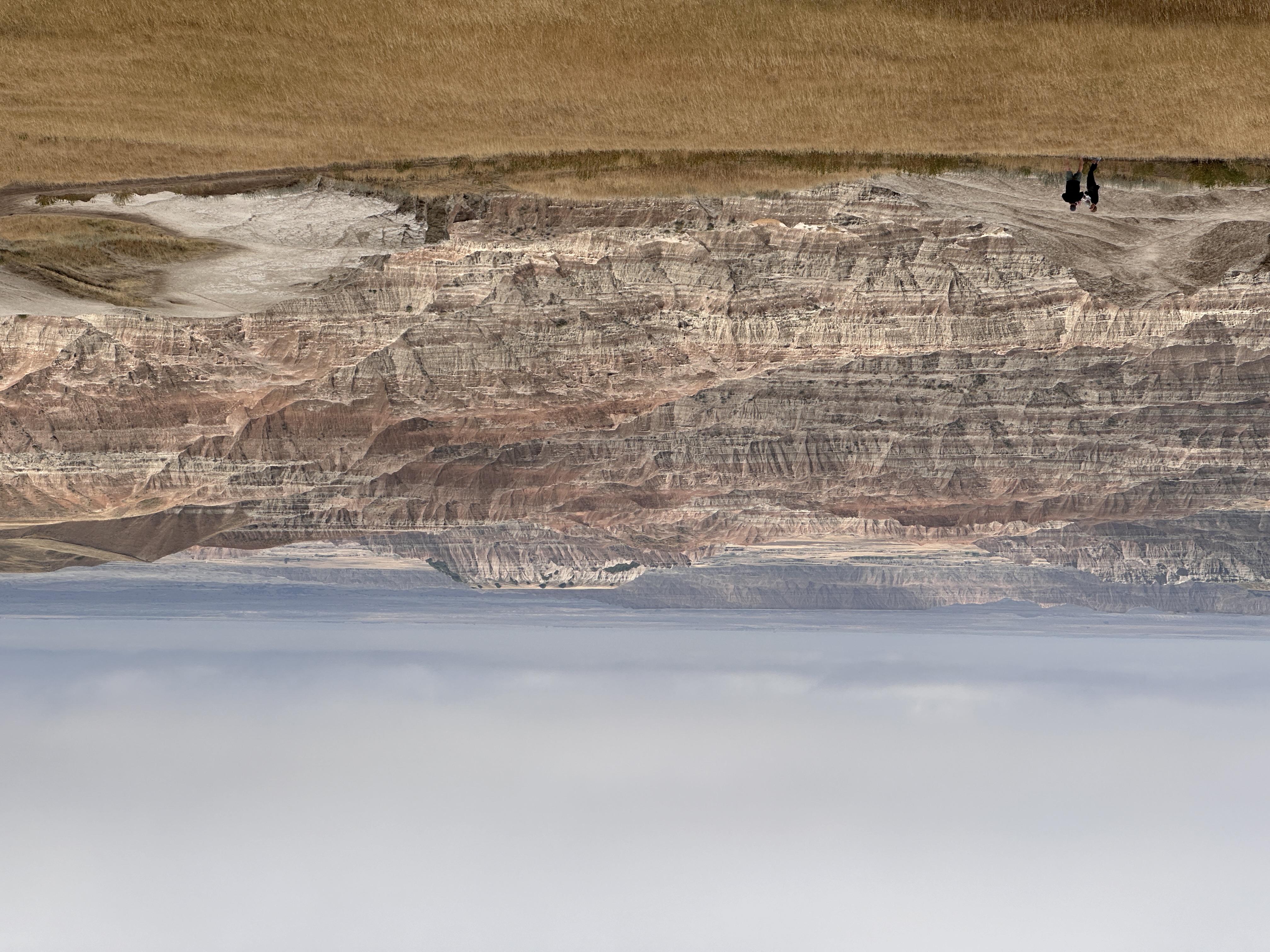
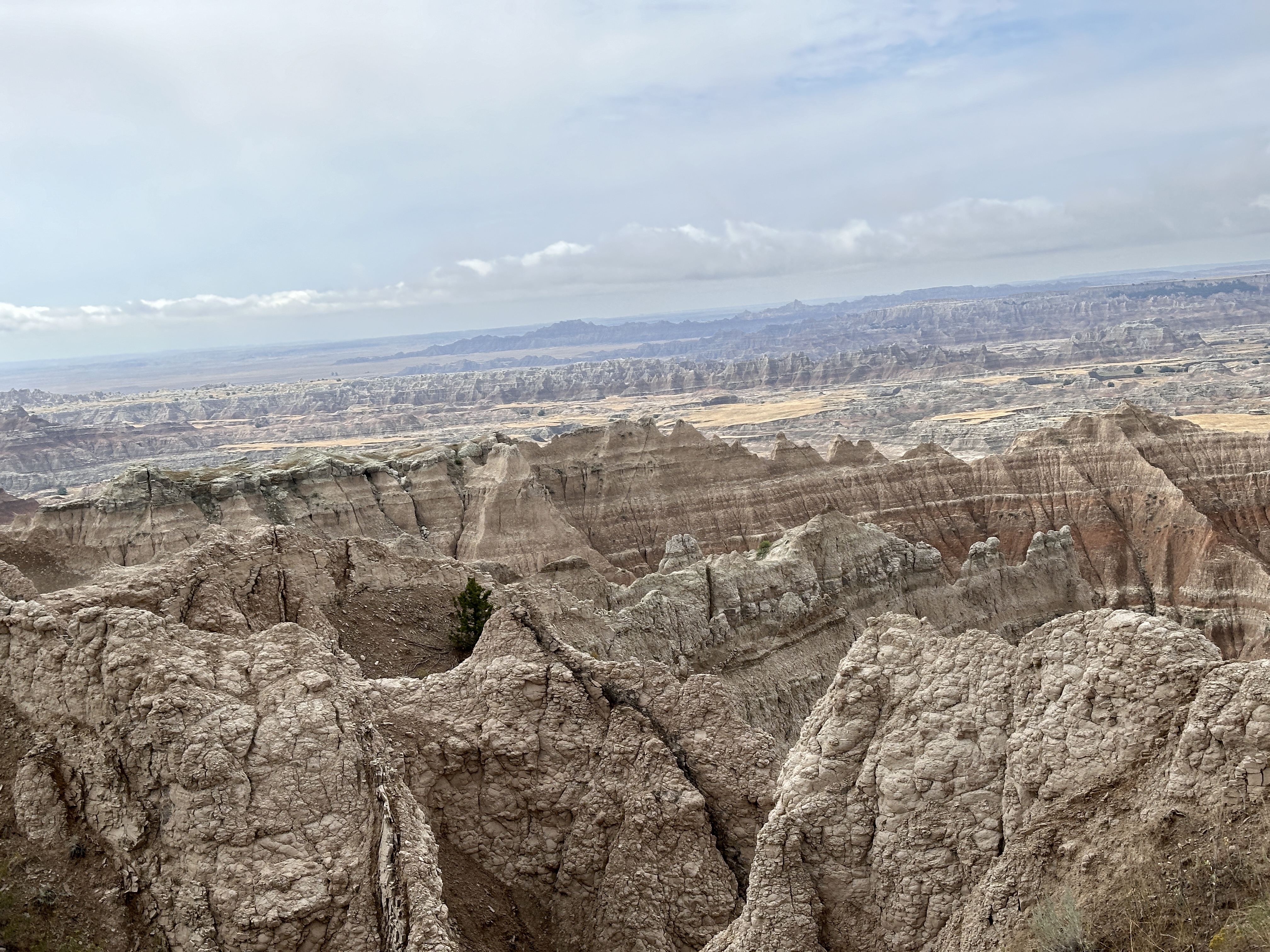
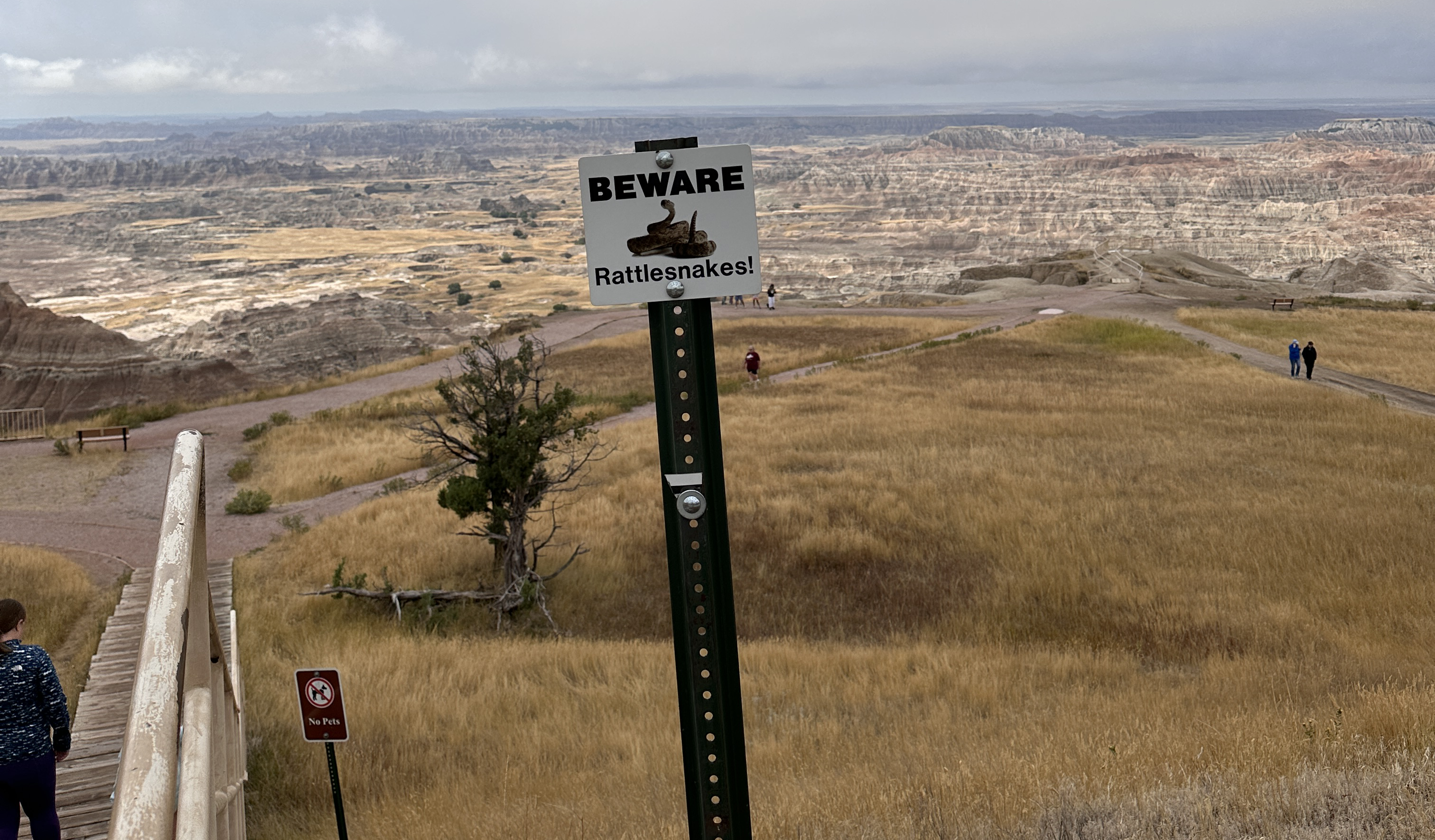
I won't show you a lot of Badland photos. Many of you have been, and others have seen pictures. The landscape, however, is definitely worth seeing. Enough so, that I bought my second lifetime senior pass to all National Parks. I bought one on another trip, and it's still my same lifetime.
Badlands landscapeA closeup of the rock formationsYou guys go ahead and explore.
I'm staying up here.
(Click to see why)
But I forgot to take the thing along. Had I remembered, I wouldn't
have known where I put it. So I happily buy my $80 park entrance fee \
on every trip. I wonder how many other lifetime things I have that I don't
remember. All the hotel, or whatever rewards I have banked in various clouds.
Pierre, South Dakota
On my way from the Badlands to Lusk, Wyoming, I stopped by the town
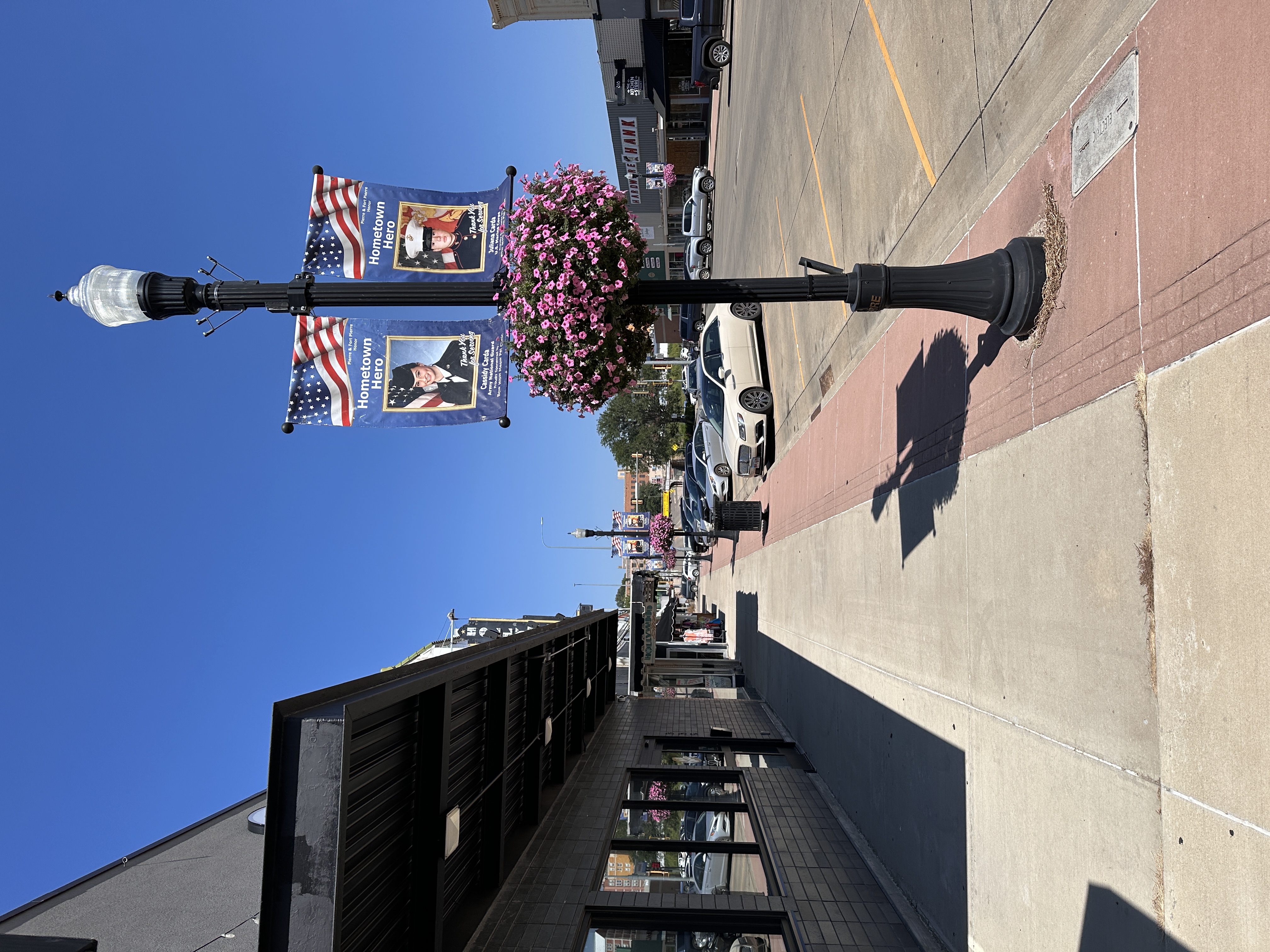
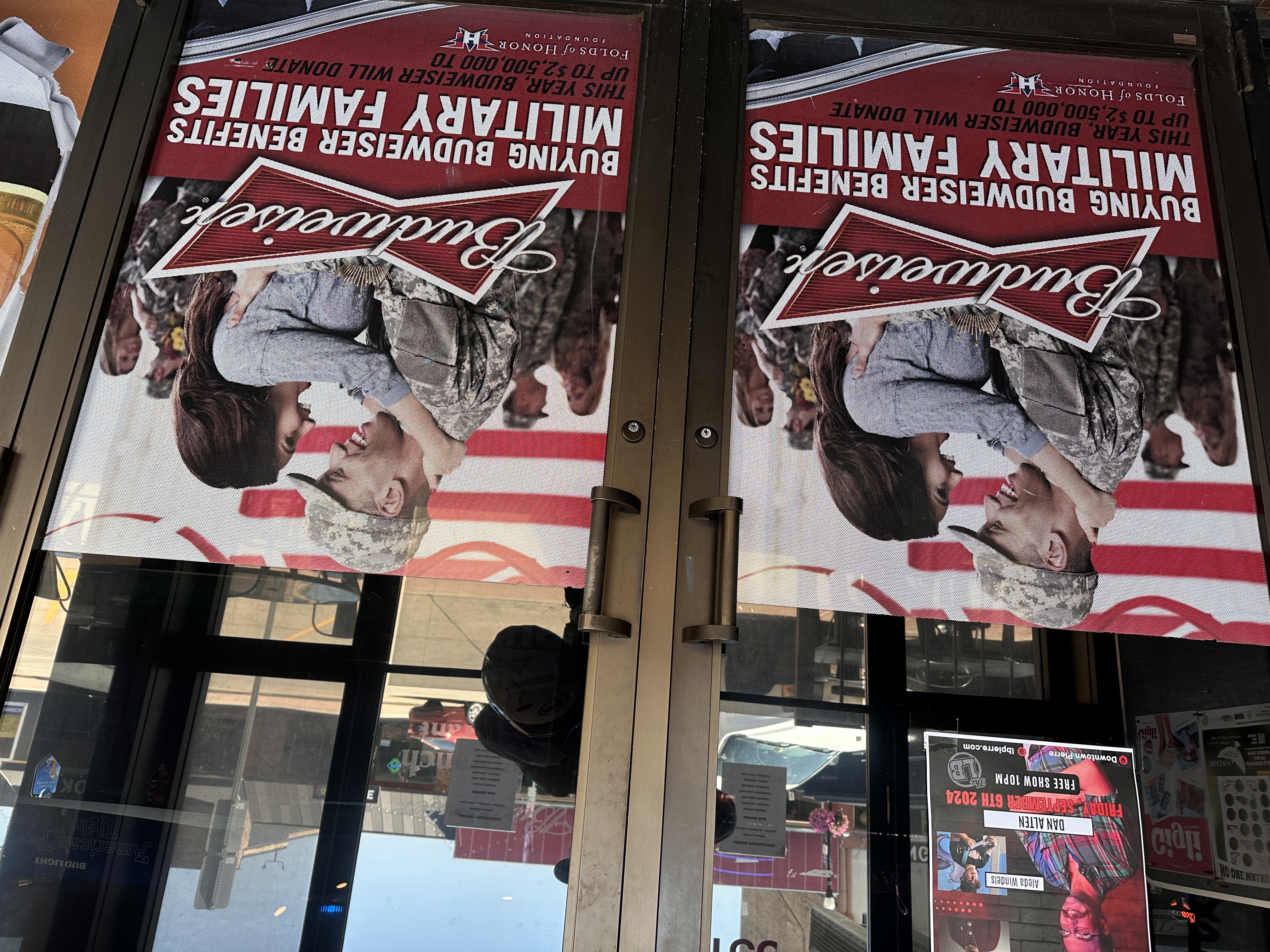
of Pierre. Quite the patriotric place.
Every lamp post is dedicated to a local hero
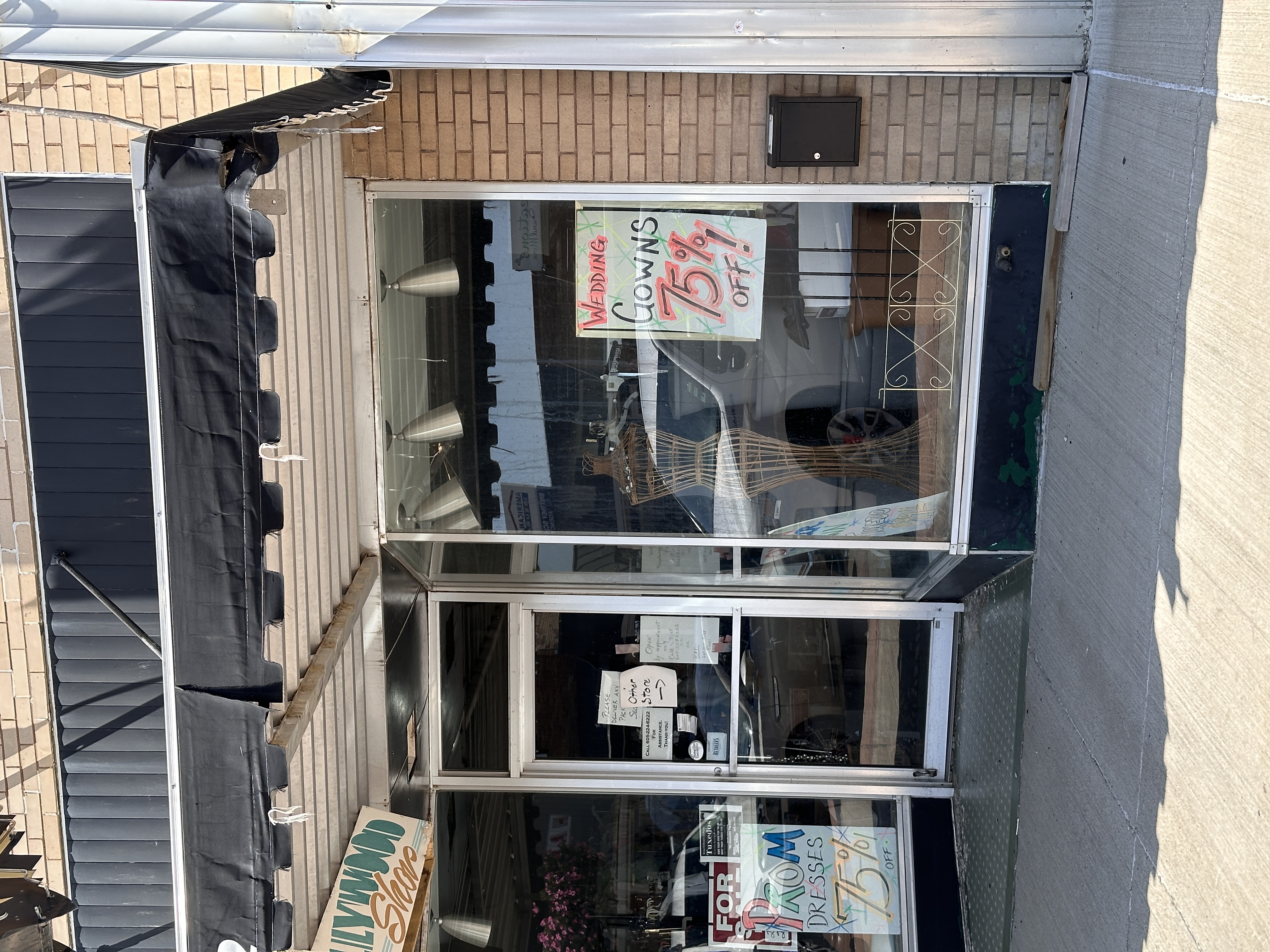
Restaurant entrance doorWedding gowns 75% off. What happened in this town?
The Black Hills of South Dakota are amazingly similar to the Black Forest
in Germany. It is likely the deep-green pine trees that lend the common adjective.
Somewhere in them there hills I find a little building labeled CCC Museum.
I obviously need to know what CCC stands for. And so do you.
I tie up my steed in the parking lot, plunk my helmet on the cement next to it,
and go in. You wonder why I am unconcerned about theft of my helmet? Neither
South Dokata nor Wyoming are helmet states. So why bother stealing one?
I am barely inside when all hell breaks loose outside. Torrential rain,
thunder, hail. It's really coming down. My helmet outside, visor wide open. Got
to look at the bright side: my body will be dry, even as my head will soak in
ice water saturated helmet padding. It's a body half dry, half wet type thing.
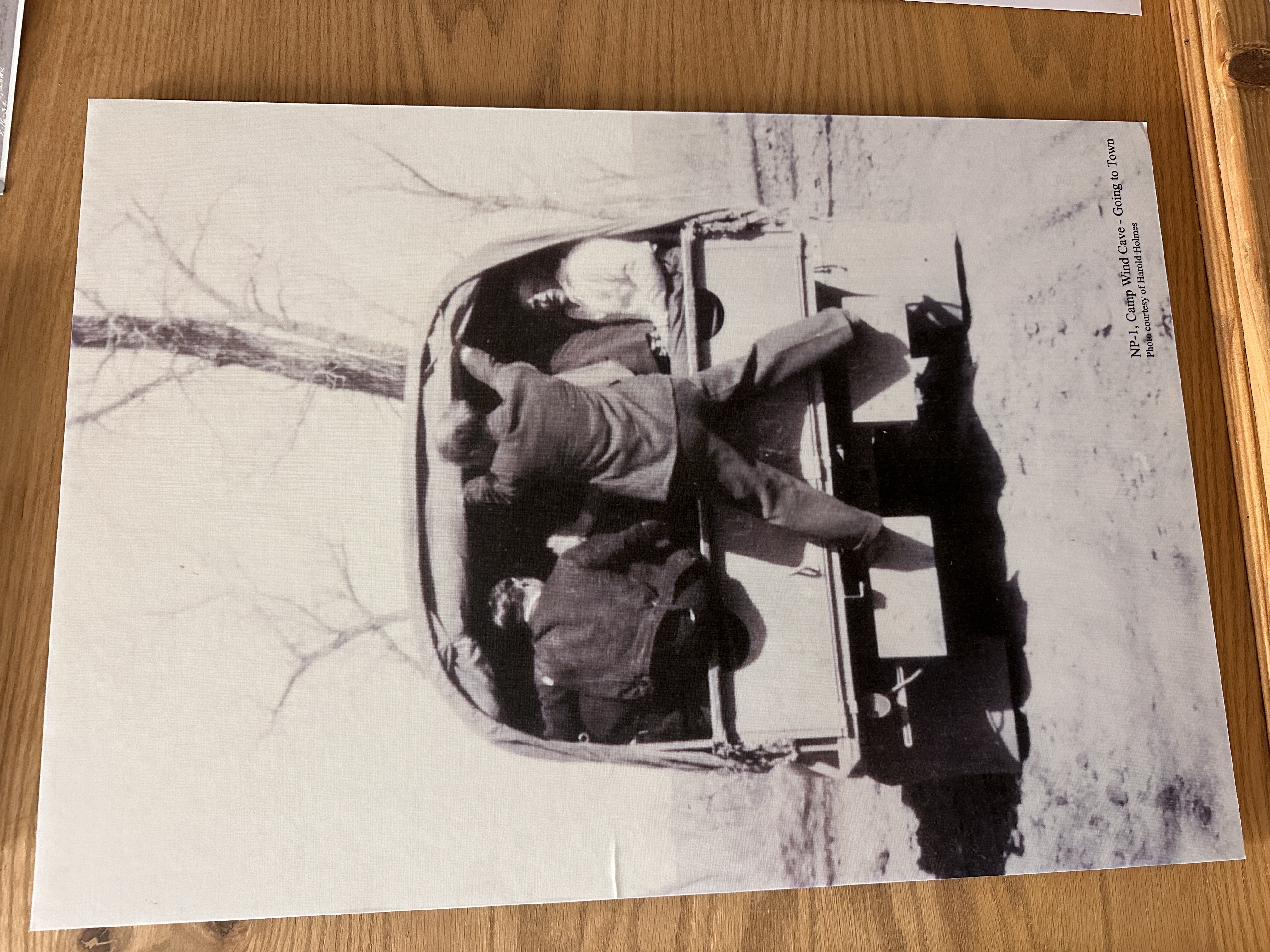
The museum honors the Civilian Conservation Corps. of the Depression era.
To qualify, you were unemployed and male. First stop was Ft. Meade, SD, where you were physically conditioned. Then you moved to one of the conservation sites, such as in SD.
Safety first! No nanny state there 😉
You signed up for six months, and received $1/day. Of which you got to keep $5.
The rest was sent to your family. The men's Black Hills work has remained significant to this day. However, unsurprisingly to a Euro like me, the program was attacked as being Socialist. Better to have young, unemployed men coalesce into gangs, or starve to death than succumbing to Socialism.
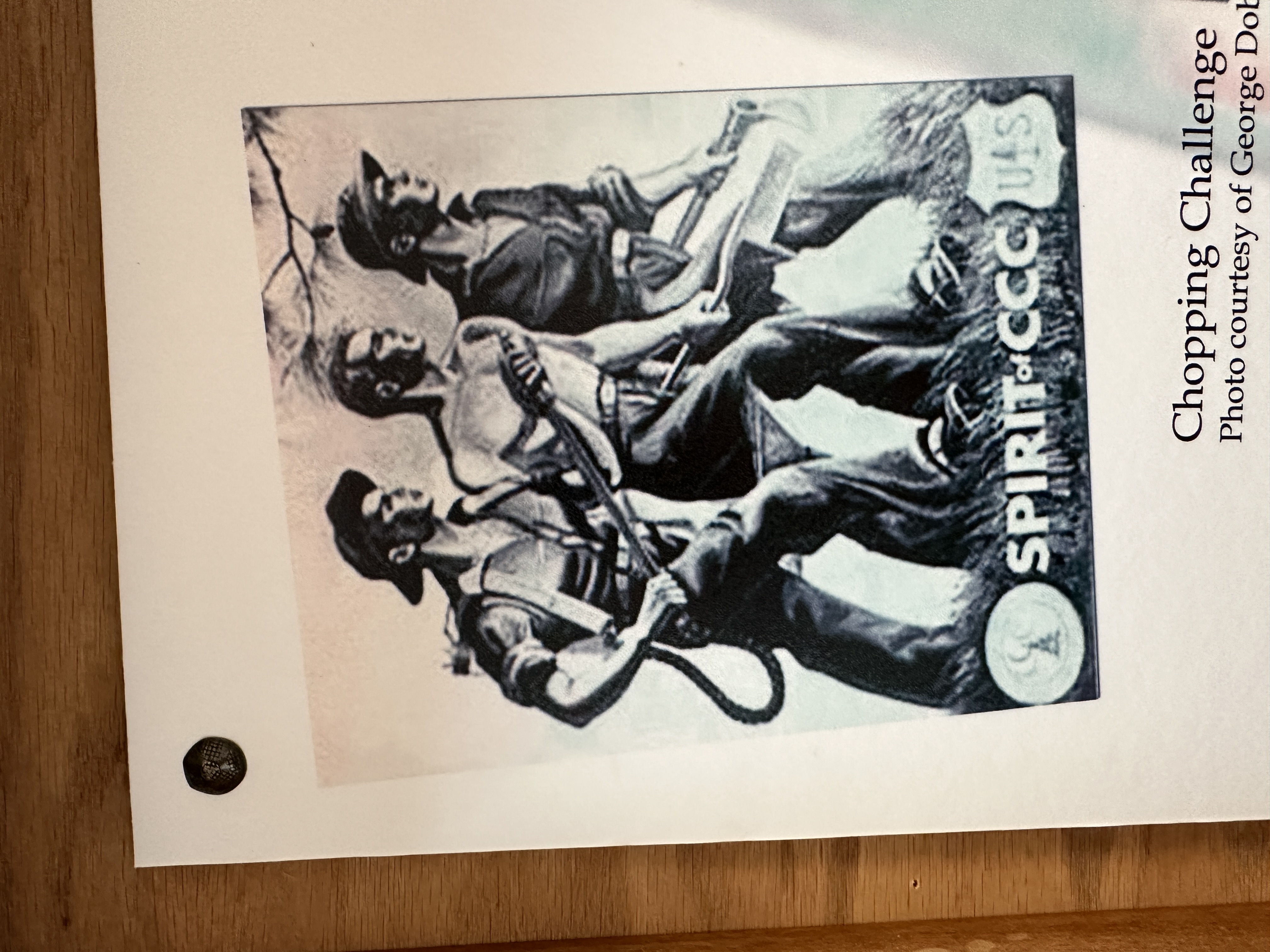
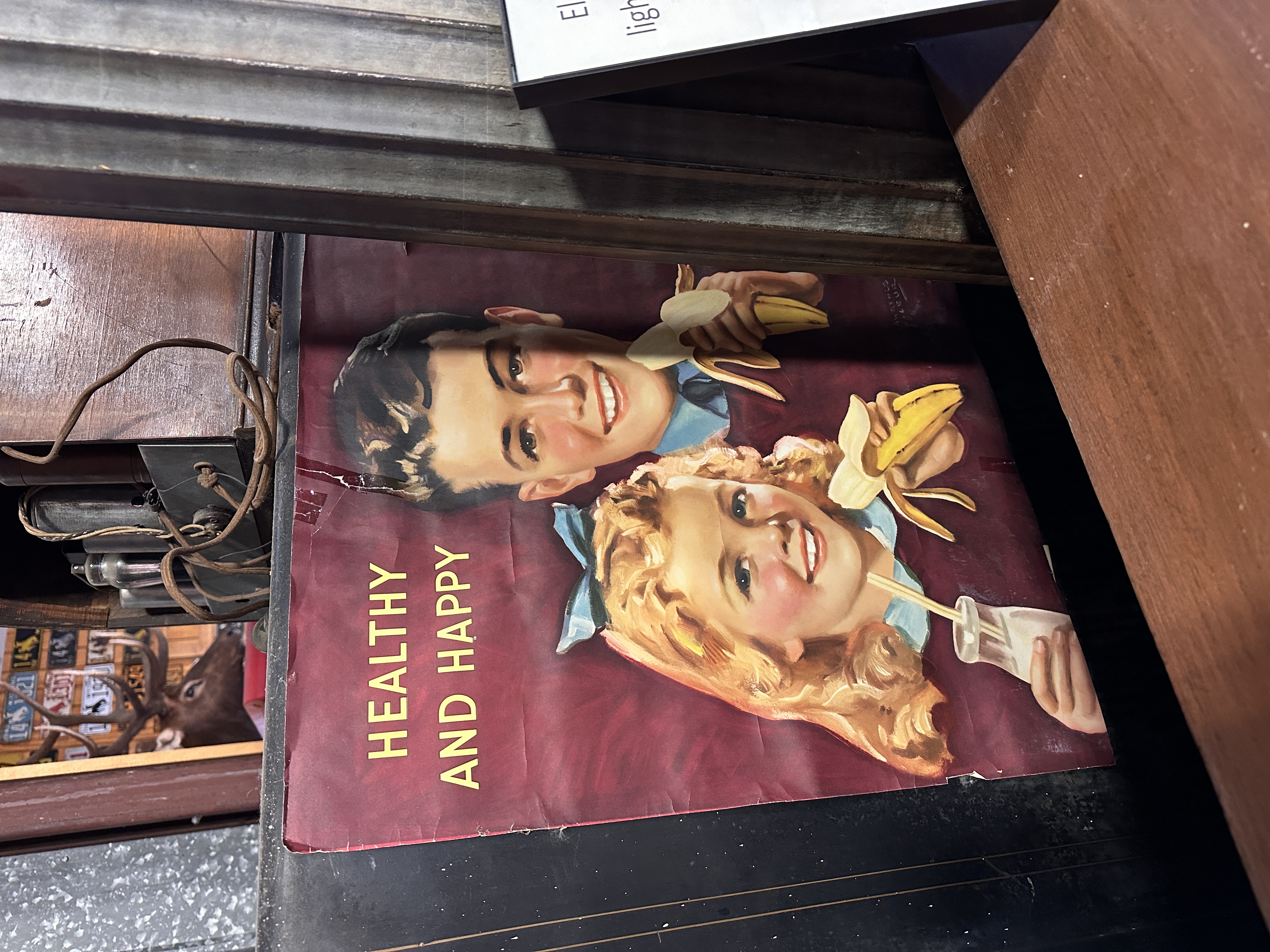
Again, the propaganda style of the day
I asked the librarian whether any blacks were included in the CCC program.
He visibly lit up at having someone ask him a question. He knew a lot. Yes, there
were black companies. Way segregated in the Southern camps. Kind of segregated in the Northern ones. It is said that the first occupants of a South Dakota camp were black, and surrounding residents rebelled. The company was removed, and replaced by a bunch of white guys from the North. Whom the residents didn't like either.
I landed in Lusk, after a 7hr ride and temperatures between 106F to 57F over two days.
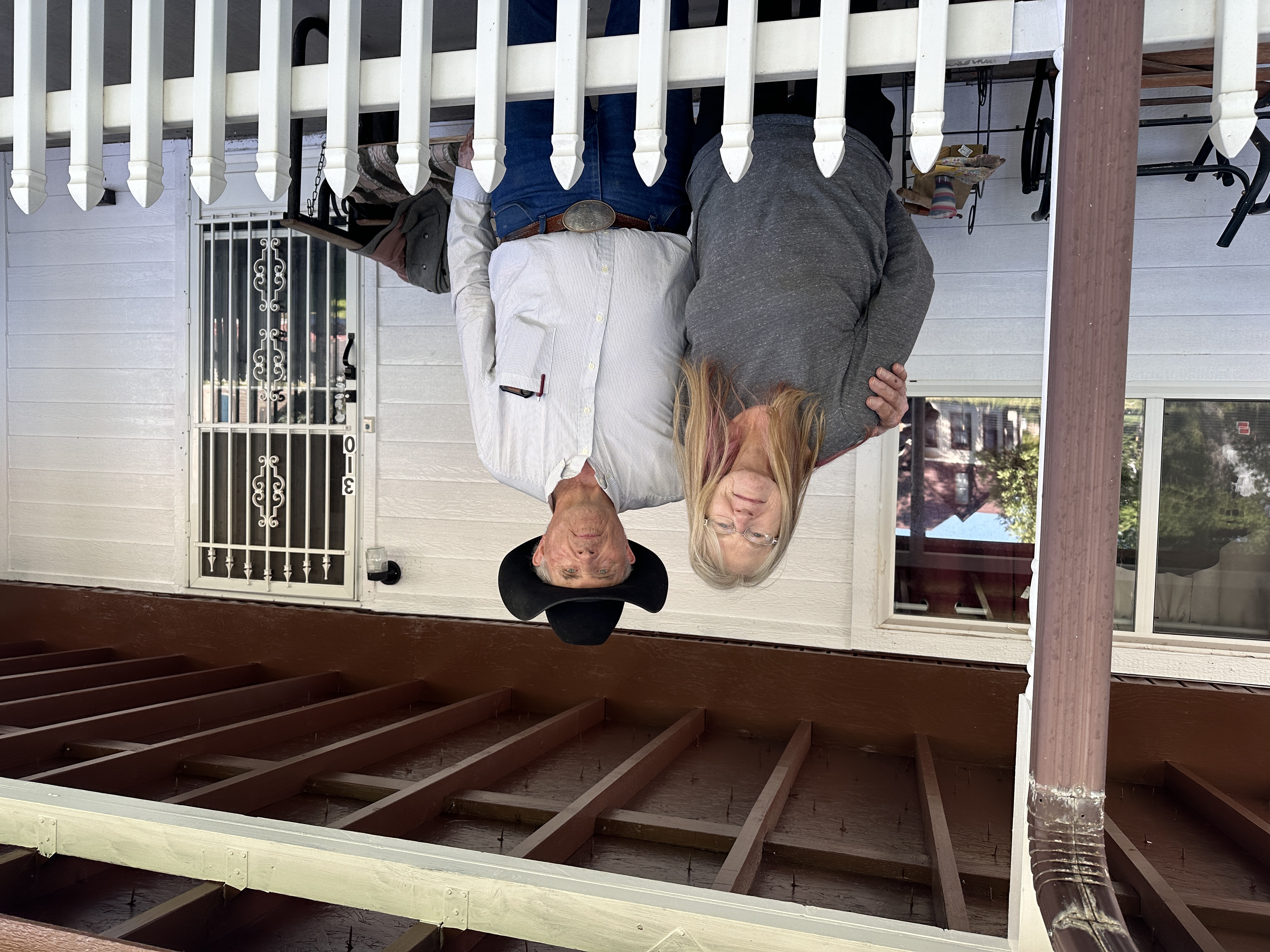
My head felt as in a vice. I slept for 14.5 hours, and am ready for a stroll. This man is just finished mowing the lawn. I see my opening, and call from the sidewalk:
That work never ends, does it?
A Wyoming rancher couple, now moved to town
I've used this line with many chicks. Always works, on account of its
originality. The two turned out to be wonderful conversation partners.
This is ranch country. He is 88, and she is not far behind. Raised on the
ranch, at age 14, he came across a cow with an inverted womb: The animal
gives birth, and her womb emerges, inside out, with the calf. He fixed the
situation on the spot. He, as well as their boys went to college, and learned
about ranching there. The boys now run the farm.
He explains: You are responsible for ensuring that all births go OK, and that
you acquire enough feed to get the animals through the winter. They stay outside,
though in a smaller area. You feed them once in some place, and they learn immediately.
They will return when they have the need.
When talk comes to Indians, i.e. Native Americans, he gives air to his opinion
that the government gave them lots of money, which they squandered. His wife instantly chastises him:
That's racist! He shrugs, and I quickly interject
Looks like you sometimes have different views.Apparently! she says with emphasis.
A small moment in a marriage. She was a school teacher, who taught many Indian children, and she laments that the kids were taken from their parents, and even today are losing their languages of origin.
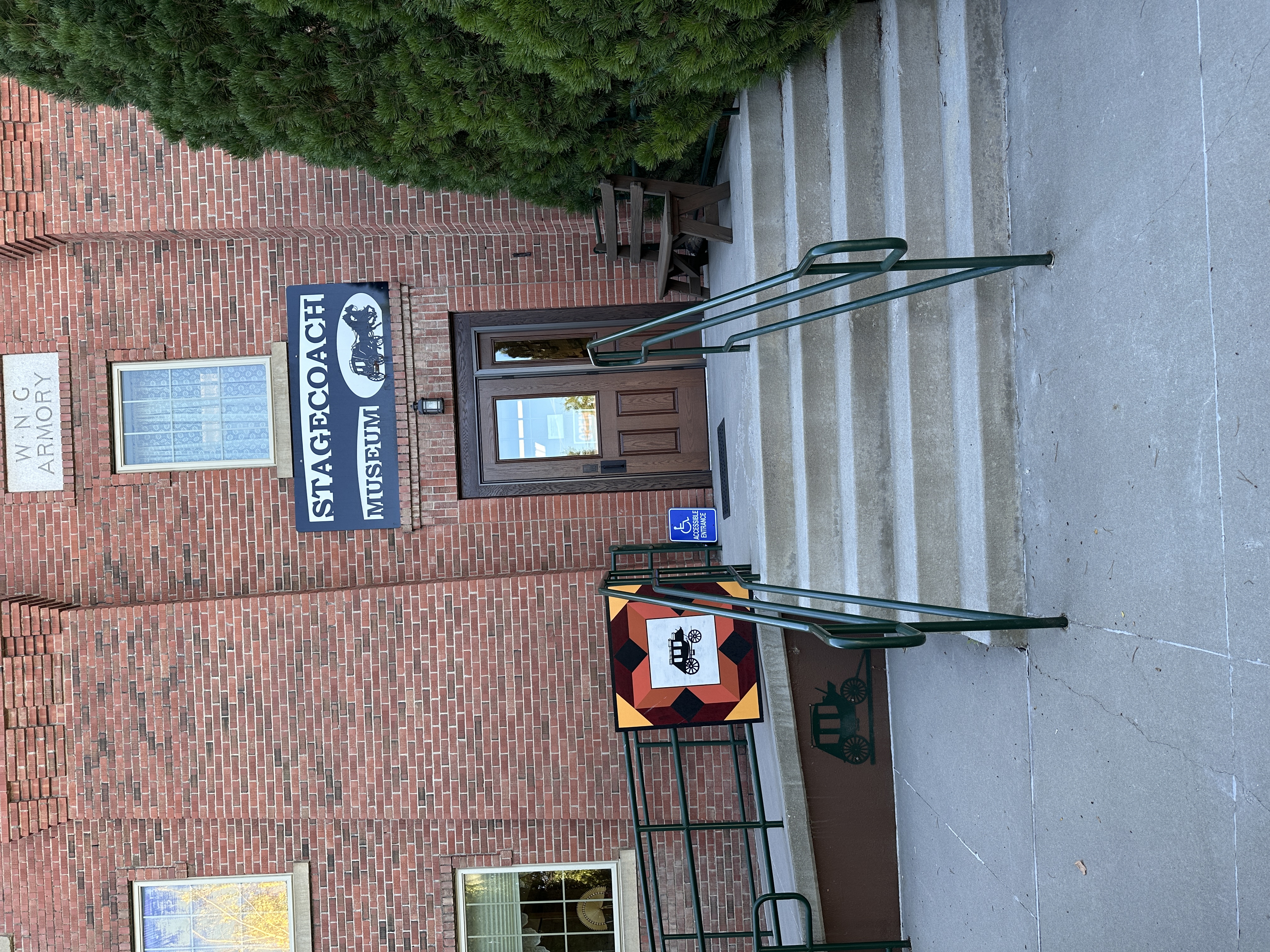
Off I go to the Stagecoach Museum.
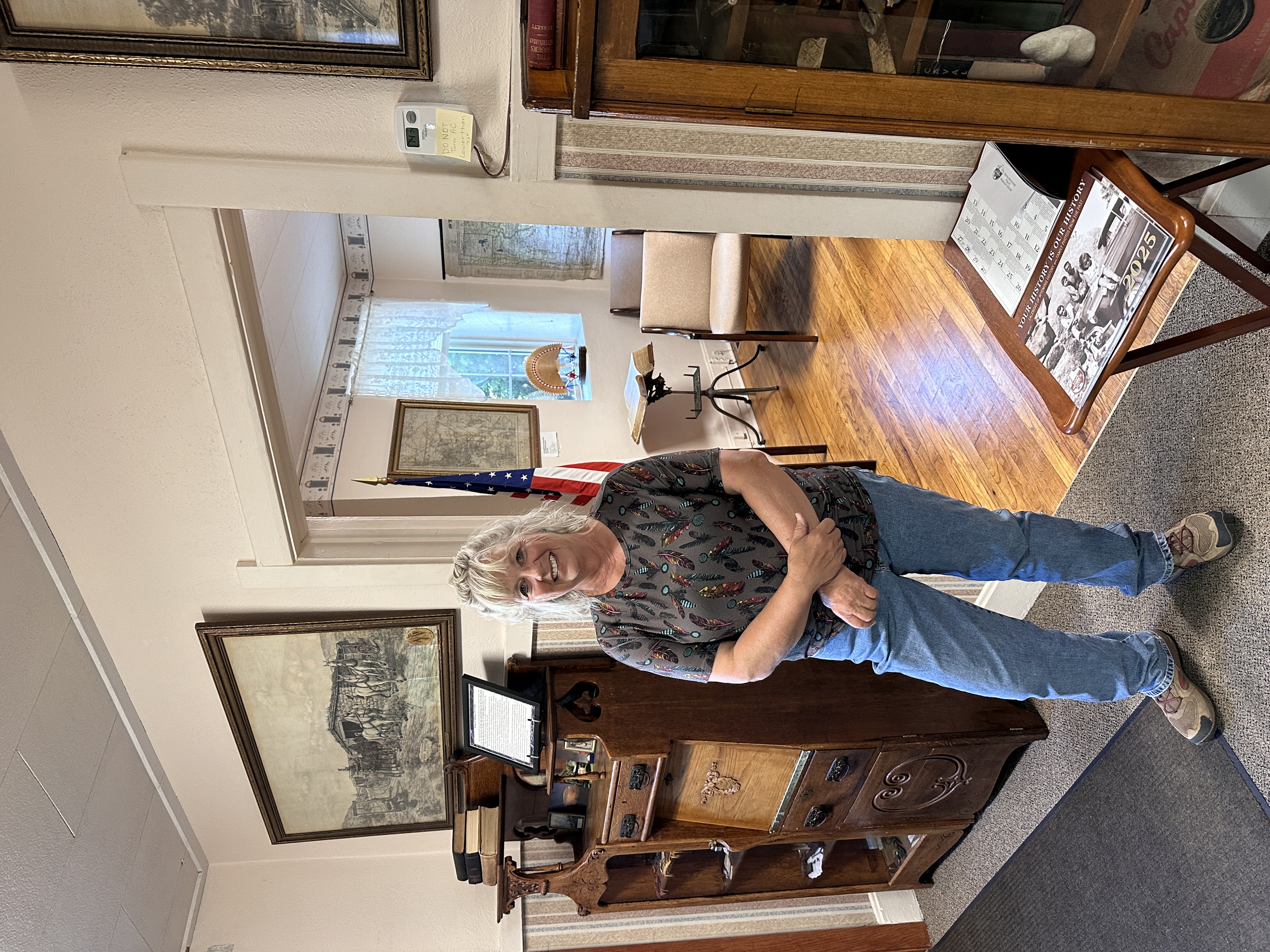
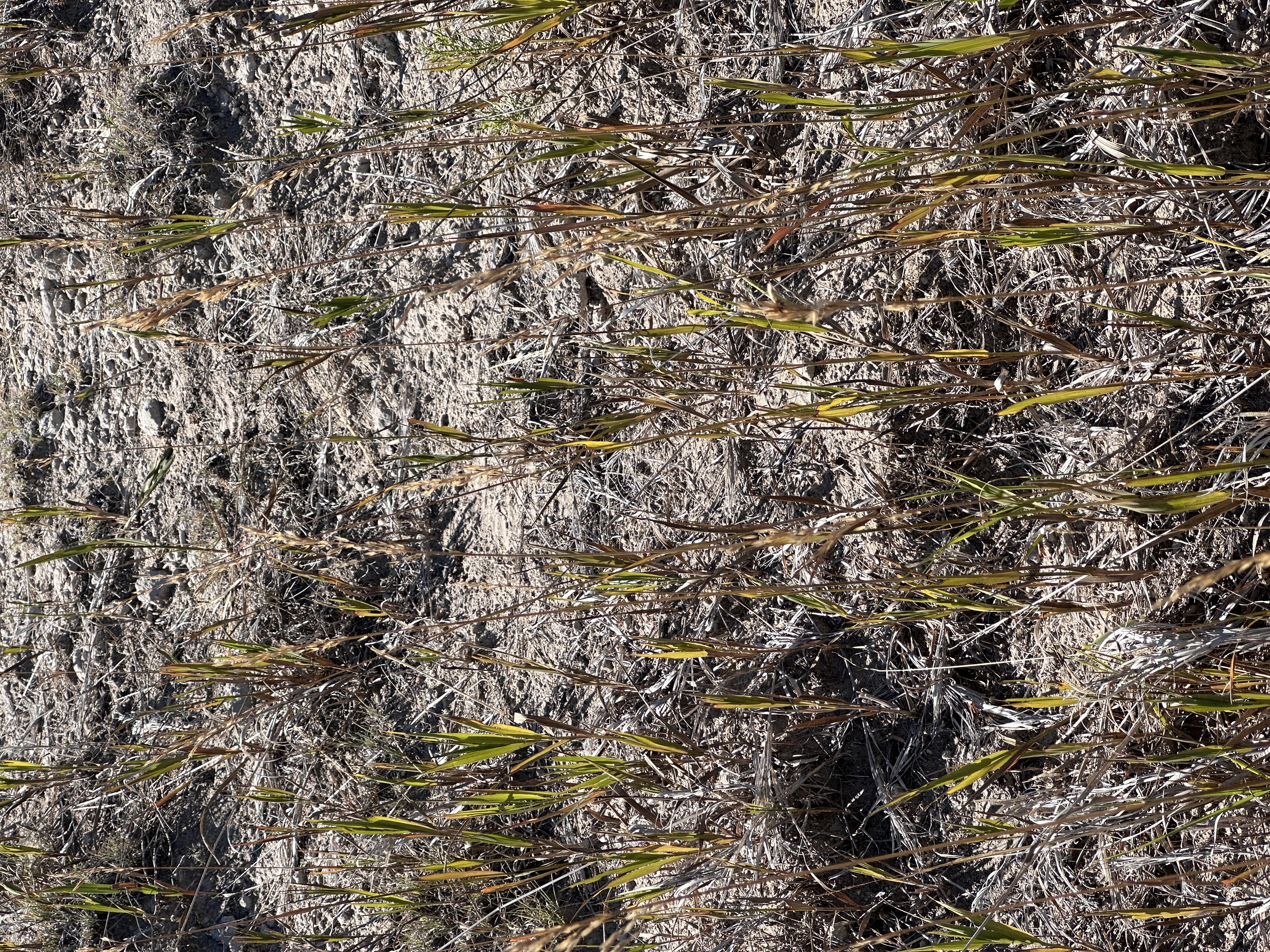
The Stagecoach Museum in Lusk, WyomingRancher and conservation enthusiastRehabilitation work
needed on the soil
The volunteer inside is a Western history buff, and a rancher.
In her 50s, her interest is land conservation. On her ranch they follow
special herd location schedules that allow for land regeneration. Part of
their land grows non-native species of grass that supports her goals.
To rehabilitate sandy areas, they sprinkle straw, and some greens on the ground.
The cattle poke around, because they are curious, and thereby fertilize the area.
Adding seeds afterwards very slowly helps vegetation to take hold.
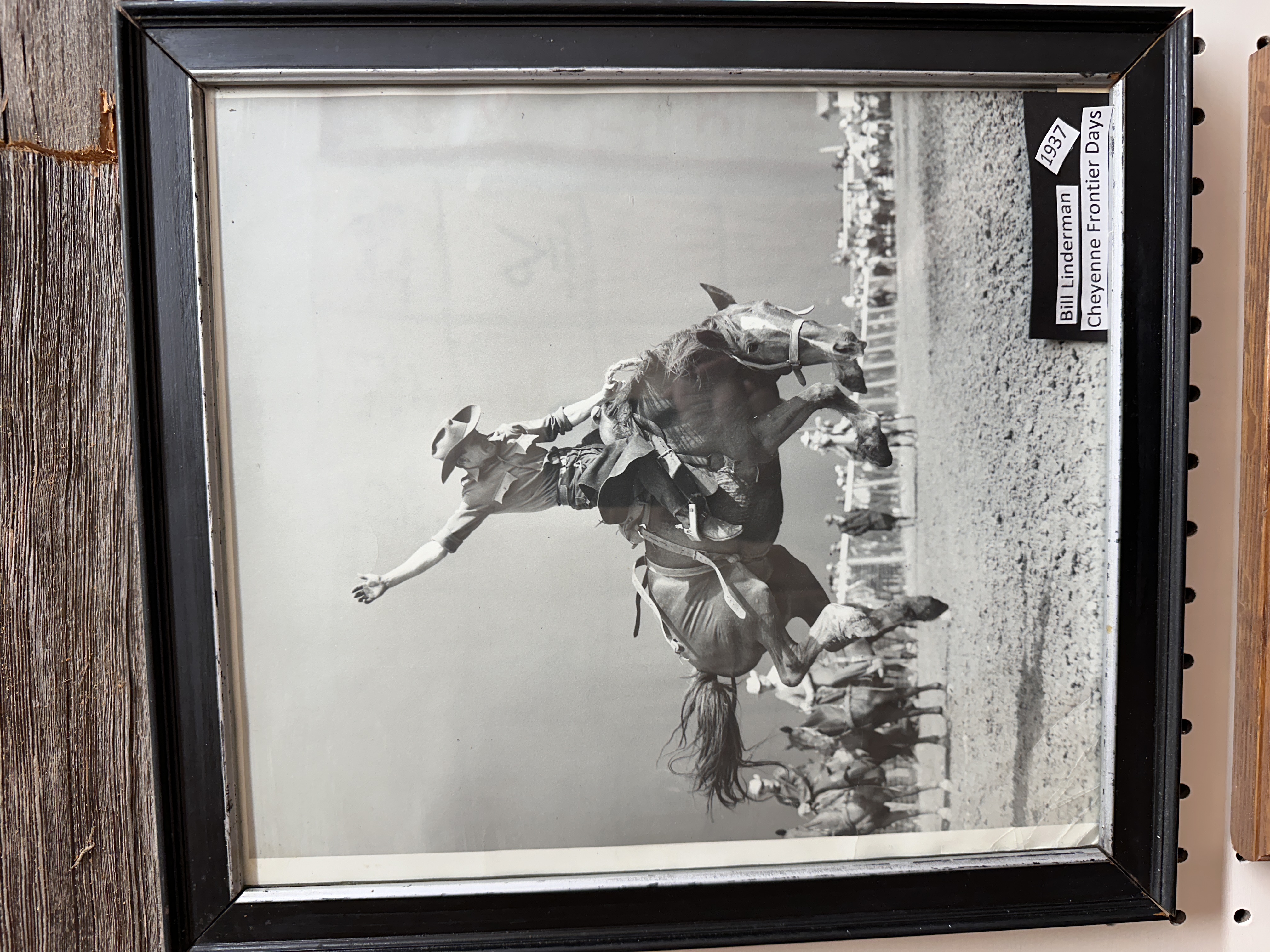
The museum is clearly in ranch country.My mother wrote her books on one of theseThe trouble with rodeos:
Notice the belt crushing
the horse's genitals
The rancher librarian explained that this, and a vast area North in
Wyoming were promised to Indians. Fort Laramie and another set of barracks
enforced that contract. You could not be in the area legally as a non Indian.
Along came Custer, and declared that gold was present. From one day to the next,
the soldiers switched from keeping intruders out, to protecting them.
Eventually, the government rounded up some tribal Chiefs and others, gave
them a few blankets and other trade goods, and had them sign the land away. It is
unclear even whether the interpreters were straight.
Interestingly, the chiefs were just ceremonial figures in these tribes. They
had no executive powers. And certainly no mandate to sign treaties. The tribal
societies were organized differently from Western tradition. After the fact some
tribal members objected. But too late.
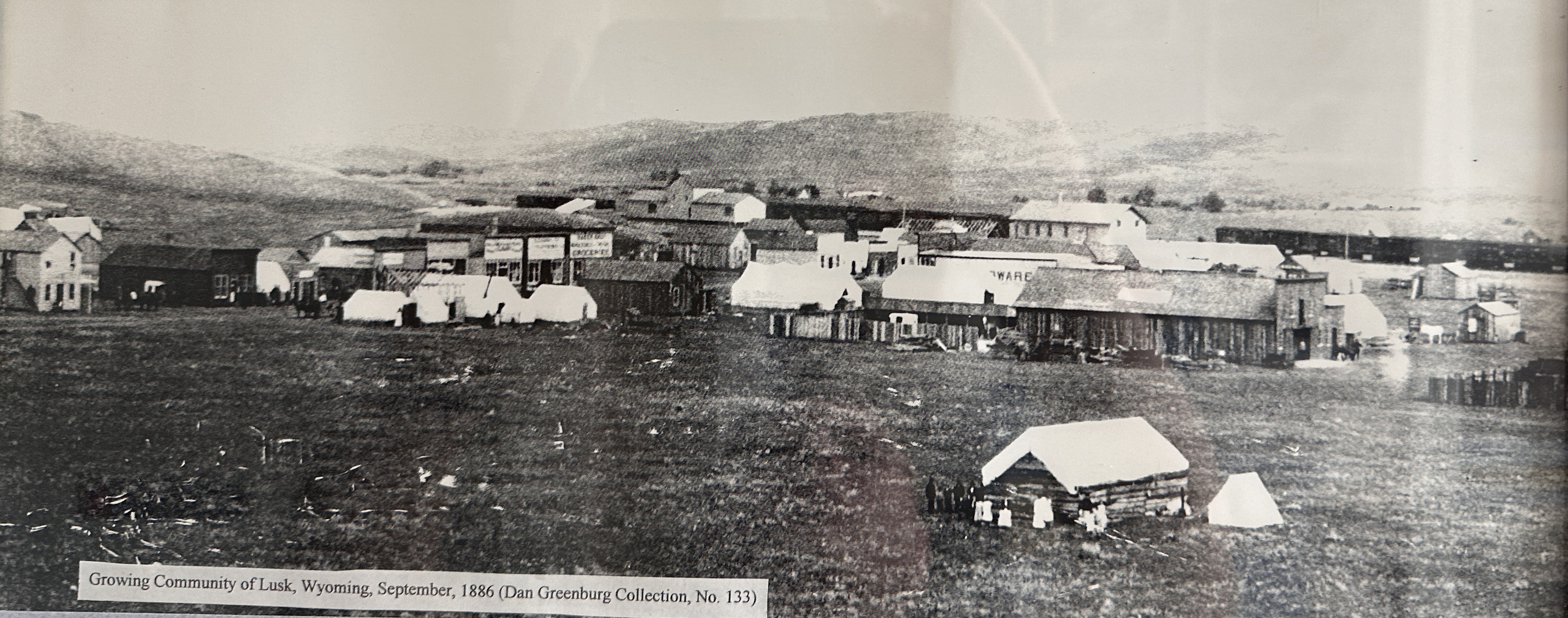
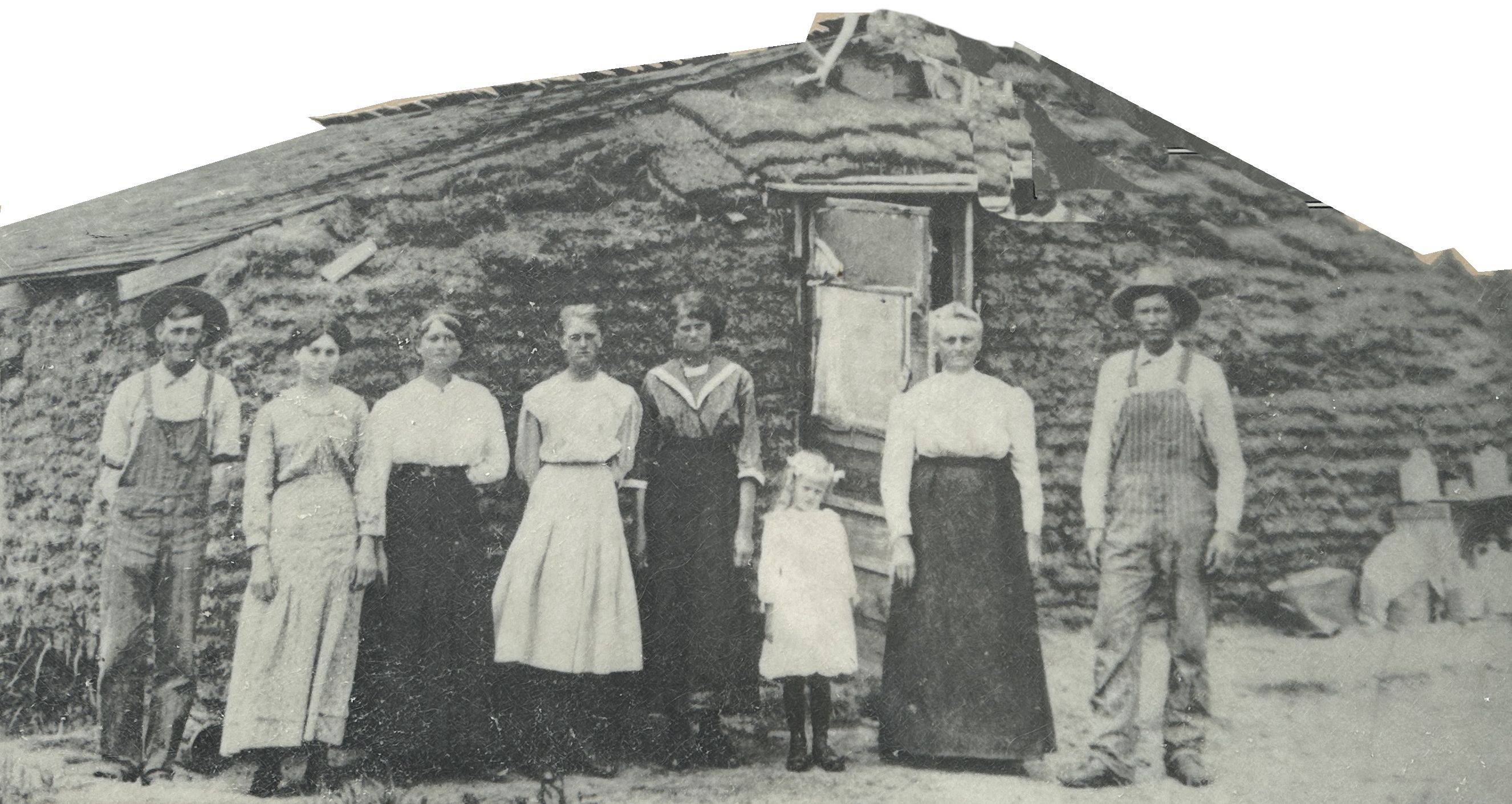
Who would want to live here???Families like these did comeAnd money was made! The Lady of Lusk
Whose idea would it have been in New York or Chicago to go homestead in Lusk, Wyoming?
Was it the husband?
Husband (reading the paper): What do you think, Martha, should be go where winters are deadly, and summers will have us work like farm animals? Where births are a coin toss over who of the two parties survives?
Martha (sewing):
Why, Henry, that sounds like a lovely idea. I'll get a few things together.
The receptionist in one hotel described Winter here like this:
It's not the -20F temperature. Below 0F it all feels the same. It's the 40mph wind that gets you.
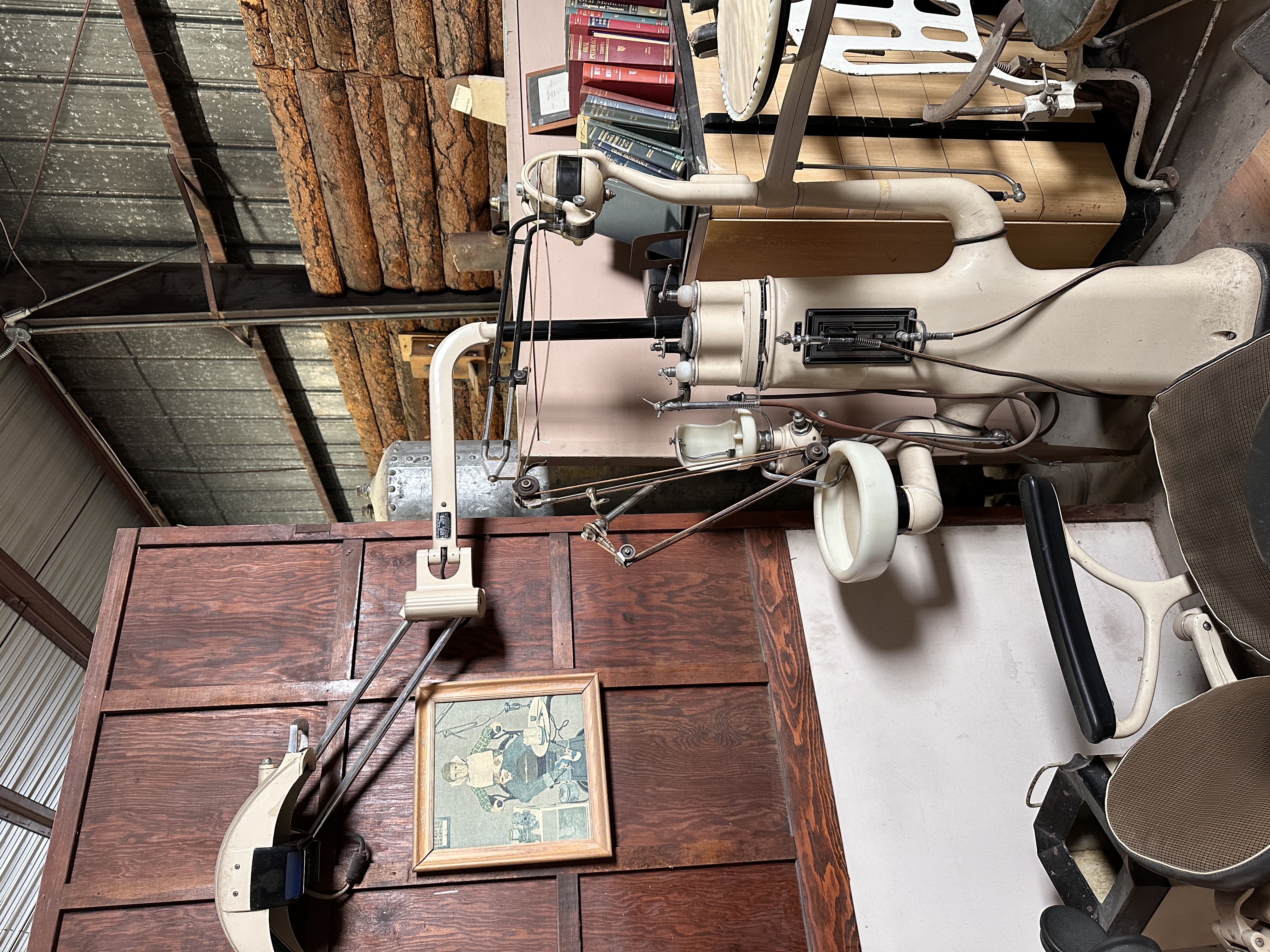
This exact type
of drill penetrated
the cavities of my
milk teeth!
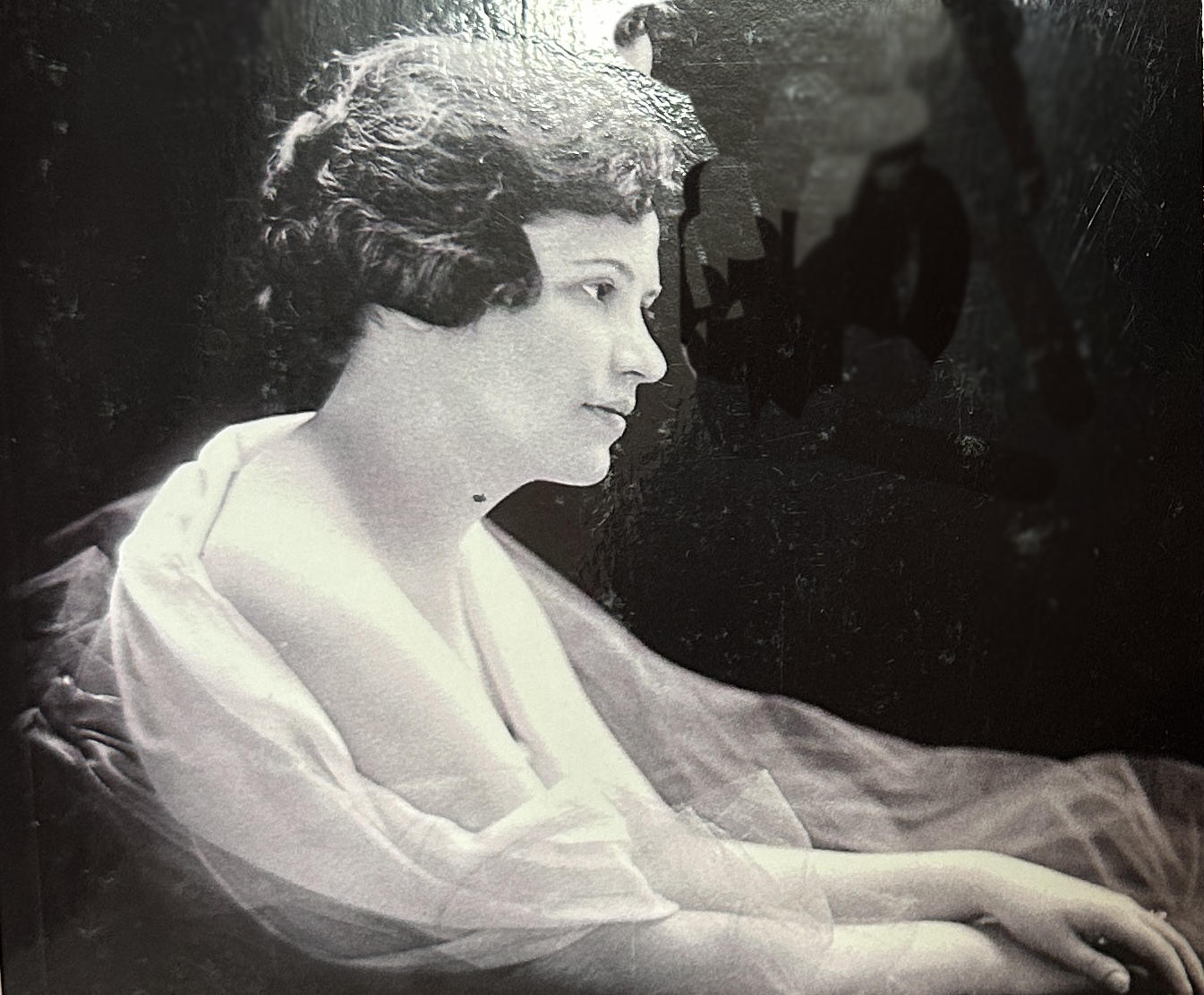
Once Lusk was born, Madam Dell Burke, the Lady of Lusk ran the
Yellow Hotel, one of the most famous brothels of the West. She closed
on Sundays, because she felt her customers should be in church. Her success saved
the town from insolvency during the Great Depression.
Homestead acts provided 320 acre lots to any taker. East Coasters came, and
found that on this land you could not subsist on that amount of land. So the
lot sizes were increased to 640 acres. You had to occupy the land for seven months
out of the year, and you had to make improvements. Building, etc. To the detriment
of the land, the government required homesteaders to farm. A big mistake, because the
damage from deep plowing, and lack of nutrient replenishment can be seen to this day.
Homesteaders came either from Eastern cities seeking a different life style, or were
poor—and 320 acres sounds like a lot—or via Ellis Island. Because farming
was not the way to go here, lives were short. Today, ranches are in the thousands of acres.
The Wyoming Spirit
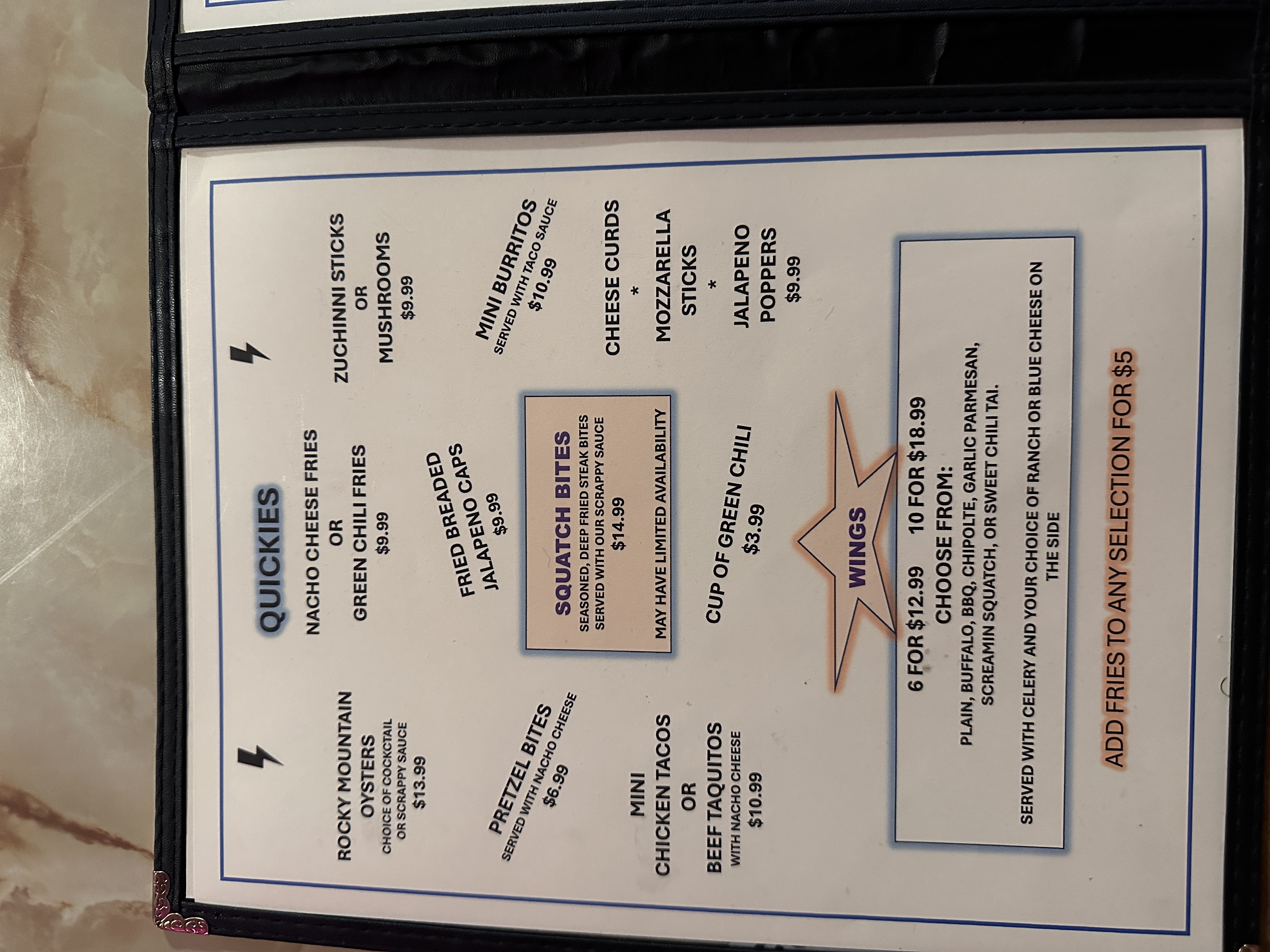
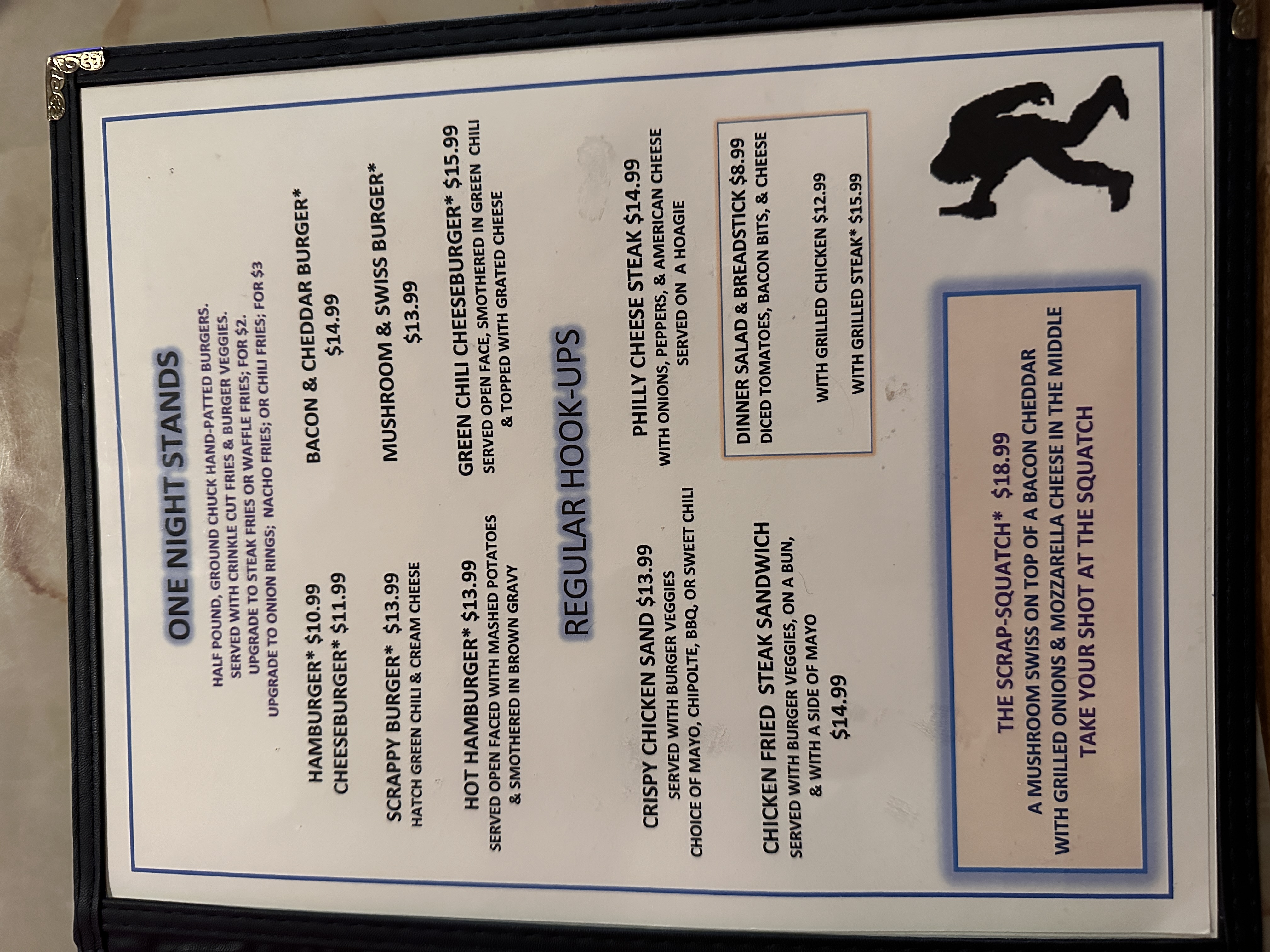
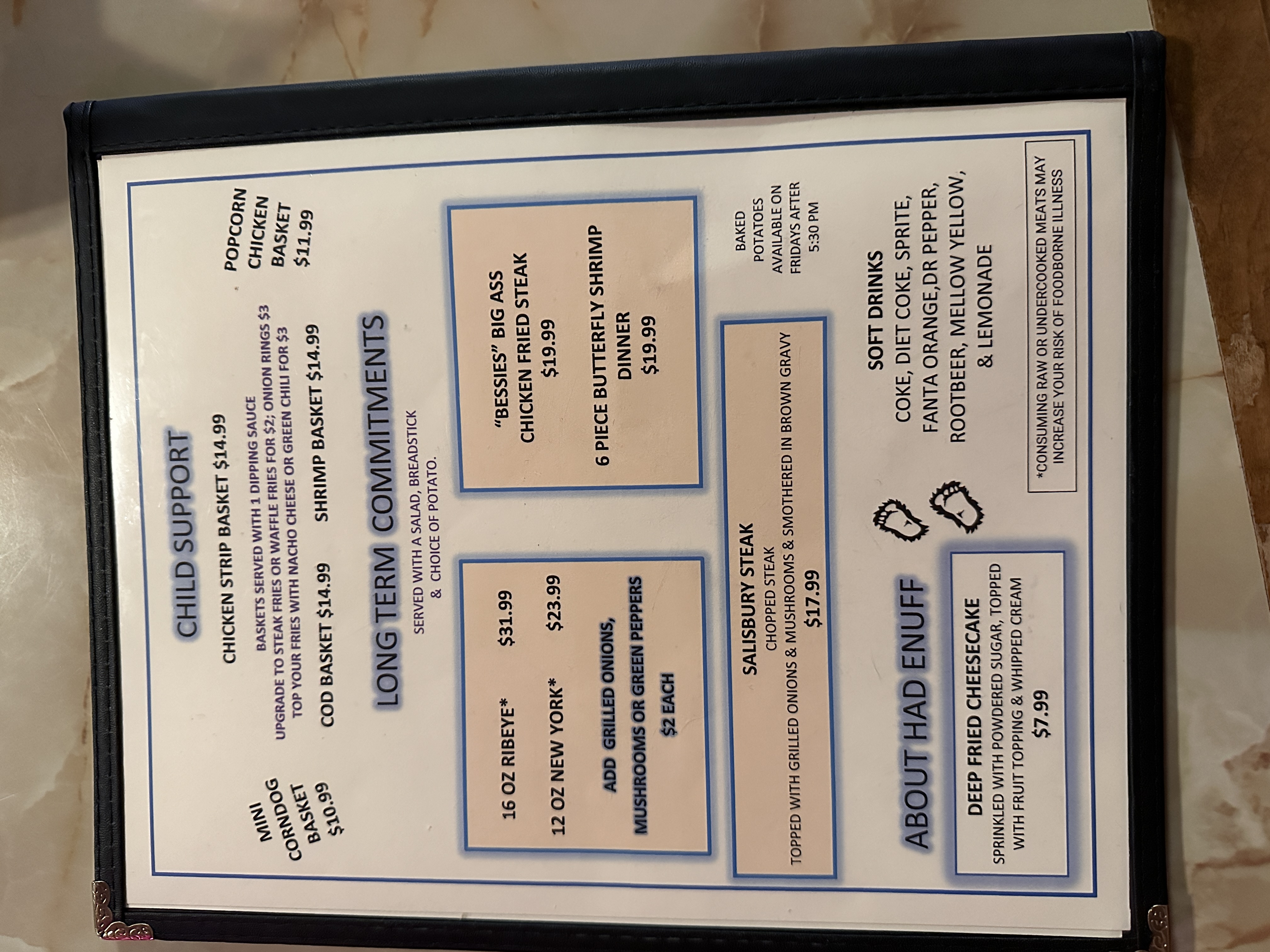
Suggestive menus don't get you cancelled in this State...
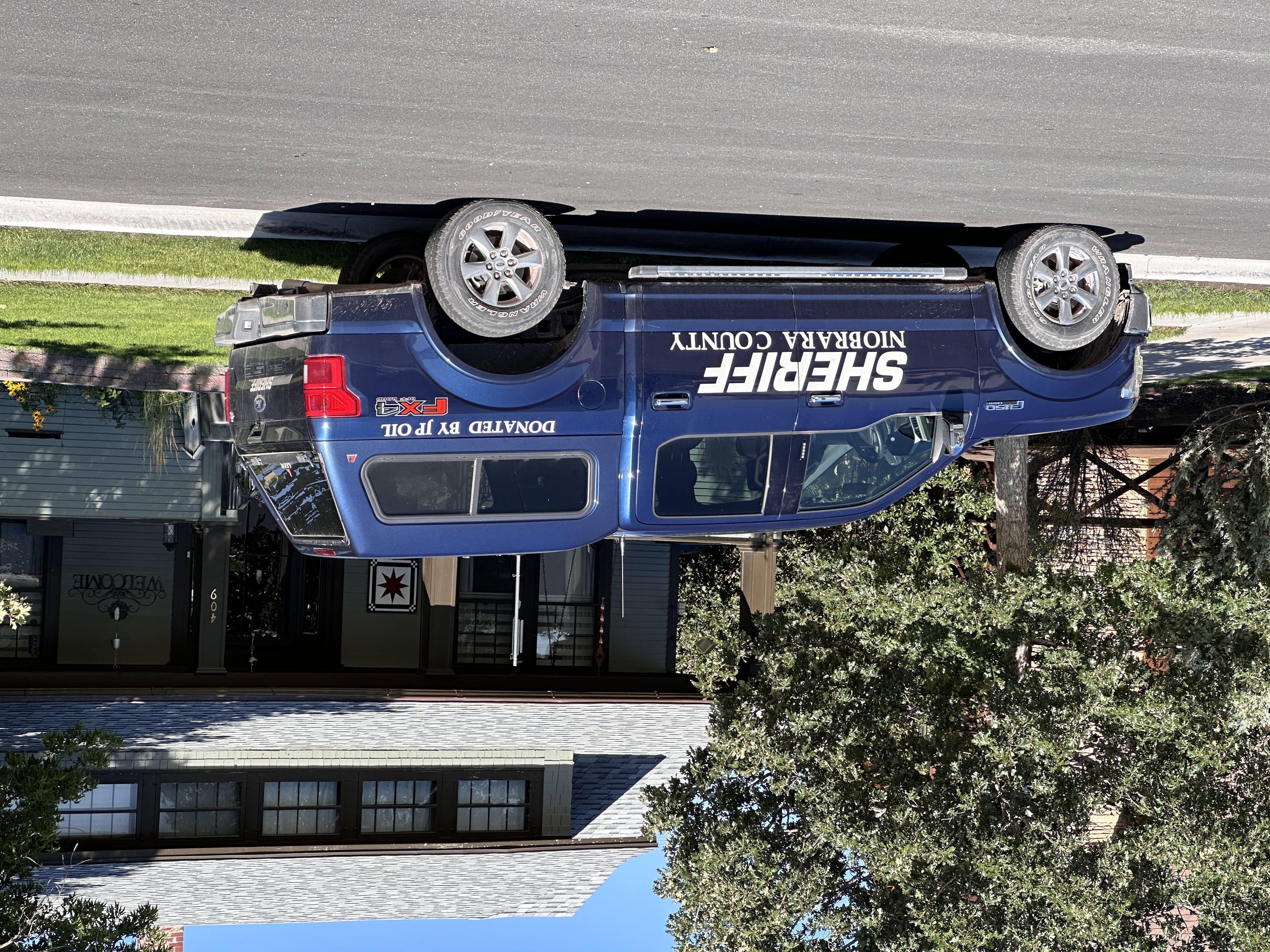
Of course...: notice the squad car donor (dbl-click image)